Microsoft Offers Voluntary Buyouts to About 60,000 Employees as AI Spending Rises — CNBC (October 26, 2026)
Article Updated: October 28, 2026
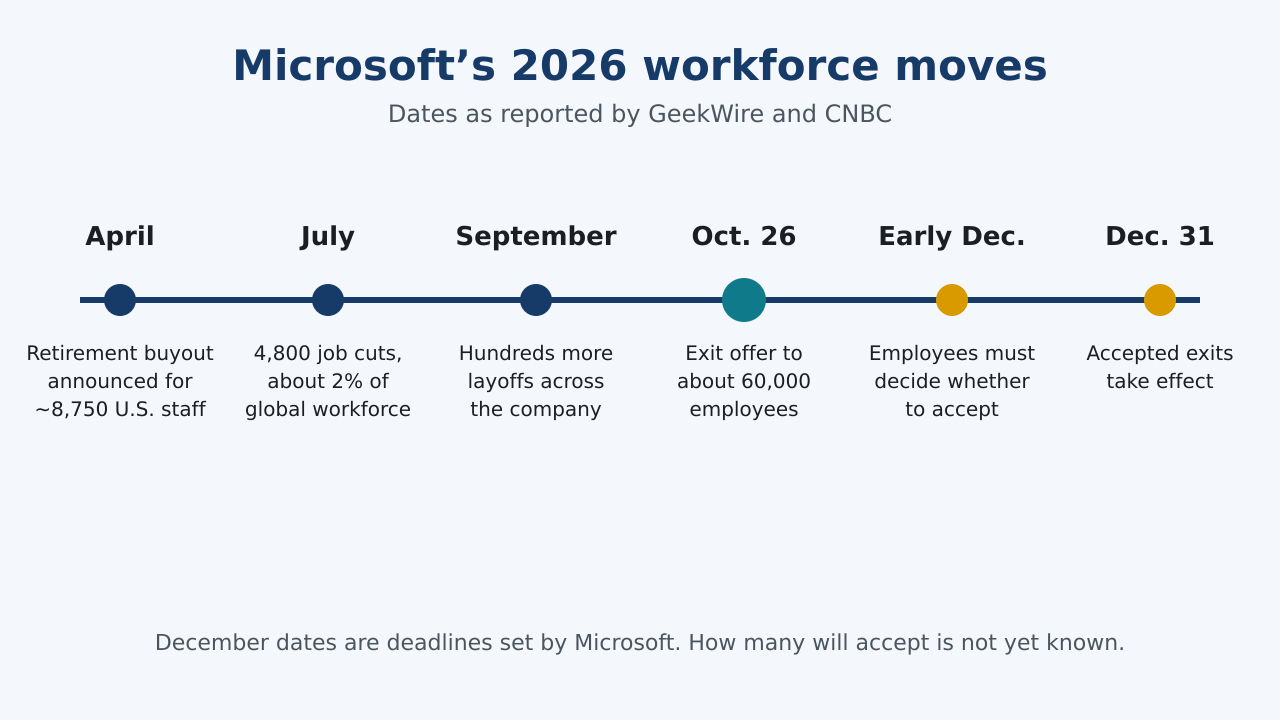
On Monday, October 26, Microsoft told employees in four countries that roughly a quarter of its workforce can now choose to leave with a severance package. It is the company’s second voluntary exit offer in six months, and it is far broader than the spring program that reached only long-serving U.S. staff. The timing matters: Microsoft is spending heavily on AI infrastructure while Wall Street watches its operating costs, and workers are asking whether a “voluntary” exit is really optional.
Key takeaways
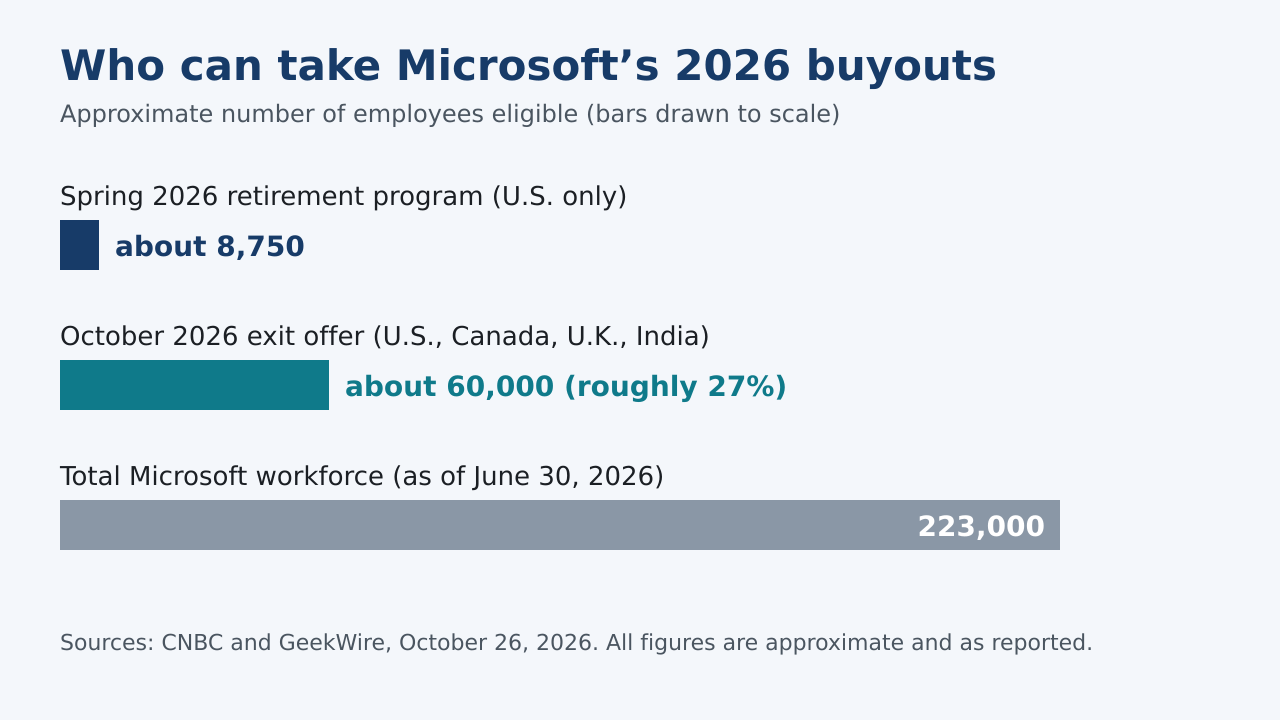
- About 60,000 employees, roughly 27% of a 223,000-person workforce, are eligible in participating teams in the U.S., Canada, the U.K. and India.
- The package matches Microsoft’s standard severance. There is no age or tenure requirement, and employees decide by the first week of December and leave on December 31.
- Microsoft says the offer is not a replacement for layoffs, which remain part of its approach.
- Nobody outside Microsoft yet knows how many will accept. The company expects far fewer than the roughly 30% who took the spring offer.
What Microsoft announced
Chief People Officer Amy Coleman announced the “Voluntary Exit Offer” in a memo to employees on October 26. Microsoft confirmed the roughly 60,000 figure to several outlets. Participation is decided by business leaders, so eligibility depends on the team, not the individual. CNBC report
According to GeekWire, the package includes base pay based on tenure and level, continued stock vesting, healthcare coverage for a fixed period and career transition services. It does not include the extended healthcare that made the spring retirement program attractive. The offer reaches up to level 70 on Microsoft’s internal scale, which covers some employees with vice president titles but not corporate vice presidents. Read GeekWire’s details
Spring retirement program versus the October offer
| Feature | Spring 2026 retirement program | October 2026 exit offer |
|---|---|---|
| Who was eligible | About 8,750 U.S. employees (about 7% of U.S. staff) | About 60,000 employees in the U.S., Canada, U.K. and India |
| Qualification | Senior director level and below, with age plus years of service of at least 70 | Up to level 70, no age or tenure requirement, performance not a factor |
| Package | Included extended healthcare, a major draw | Equivalent to standard severance, without the extended healthcare |
| Uptake | About 30% of those eligible | Unknown; Microsoft expects a much smaller share |
| Described by Microsoft as | A one-time initiative | One of several ways to adapt to changing business needs |
Source for table: GeekWire’s October 26 report. Other outlets list different participating and excluded groups (see “What is unknown”).
Why now: AI spending and cost pressure
What is reported: CNBC describes the offer as part of Microsoft balancing a costly AI infrastructure build-out with capital efficiency. GeekWire adds that Microsoft, like its peers, faces pressure from Wall Street to hold down operating expenses while it invests tens of billions of dollars in data centers.
What Microsoft says: a spokesperson told GeekWire the offer is not a sign the company needs fewer employees. Headcount was 223,000 on June 30, down from 228,000 a year earlier, and that figure predates the 4,800 job cuts Microsoft made in July and the hundreds more in September. The company cut more than 15,000 jobs in 2025.
Our analysis: a voluntary offer changes who decides and when. Coleman told GeekWire in July that the spring results reduced the size of that month’s layoffs, and that Microsoft is studying whether voluntary exits could become a regular, possibly annual, tool. That suggests this may be a standing part of workforce planning, not a single event.
What it means for job security
The offer does not tell remaining employees their jobs are safe. Microsoft has said layoffs will continue to depend on business conditions, and the company has used both tools within the same year. Workers on teams that are not participating, such as the sales organization, will not see this option at all.
Employment lawyer Domenique Camacho Moran told Fortune earlier this year that voluntary exits let employers avoid implying a person is underperforming, and that such offers can appeal to people ready to move on or confident they can find another job. That also means the people who choose to leave may be those with the most options. Read Fortune’s analysis
Illustrative arithmetic, not a forecast. Deadline reports that 3% to 5% of tech employees offered buyouts usually accept. On a pool of 60,000 that would be about 1,800 to 3,000 people. If uptake matched the spring’s roughly 30%, it would be about 18,000, a figure Forbes also calculated. Microsoft expects an outcome well below the spring rate. Deadline report Forbes report
If you are eligible: questions to ask before deciding
This is general information, not legal or financial advice. Anyone weighing the offer may want an independent employment lawyer or financial adviser in their own country, because severance, notice and tax rules differ across the U.S., Canada, the U.K. and India.
- Is my team participating, and who confirmed it in writing?
- How many weeks of base pay apply at my level and tenure?
- What happens to my unvested stock, and how long does healthcare coverage last?
- Does local law in my country add or change any entitlements?
- How does the first-week-of-December decision date and December 31 exit date fit my plans?
- What is my position if I stay and my team later faces cuts?
What is still unknown
Reports disagree on the details. Bloomberg lists Xbox, Windows, Copilot and finance among participating divisions, while Reuters’ source names AI experiences, human resources and Windows + Devices as included and marketing, commercial business and security as excluded. TechCrunch says data center, sales and marketing staff are excluded. Microsoft has not published a full list. TechCrunch report Bloomberg report
Two financial details are also open. Microsoft took a $900 million charge for the spring program in its April earnings report, and it reports quarterly results on Wednesday afternoon, which could include a cost estimate for this offer. This article does not include those results because they had not been verified at the time of writing.
Frequently asked questions
Is this a layoff?
No. Employees choose whether to accept. Microsoft says it is not a replacement for layoffs, which can still happen.
Who is eligible?
Employees at or below level 70 in participating teams in the U.S., Canada, the U.K. and India, with no age or tenure requirement. Sales and some engineering and corporate groups are not participating.
How many people might leave?
Unknown. About 30% of eligible staff took the spring offer, but Microsoft expects a much smaller share this time.
When must employees decide?
By the first week of December. Those who accept leave on December 31.
Looking for more headlines? Browse the site’s news sections for related technology and business updates.
Browse Latest News Browse trending stories
Sources and references
Reporting dates are October 26, 2026 unless noted. Microsoft’s own memo was published on its website according to TechCrunch, but a direct URL was not verified, so it is not linked.
- CNBC, “Microsoft offers voluntary buyouts to 60,000 employees as AI leads to efficiency push.” Read the source
- GeekWire, “Microsoft makes new ‘voluntary exit’ offer to about a quarter of its workforce, including some execs.” Read the source
- TechCrunch, “Microsoft offers buyouts to around 60,000 employees.” Read the source
- Bloomberg, “Microsoft to Offer Buyouts to 60,000 Workers in New Cost Cut.” Read the source
- Reuters via The Business Standard, “Microsoft offers buyouts to around 60,000 employees to contain costs.” Read the source
- Deadline, “Microsoft Offers Buyouts To 60,000, About A Quarter Of Its Workforce.” Read the source
- Forbes, “Microsoft Offers Buyouts To 25% Of Company.” Read the source
- Fortune, “More than 90,000 tech workers have been laid off this year. But here’s why companies like Microsoft are offering voluntary buyouts instead” (April 26, 2026). Read the source